Communitas Mercatorum Stapule Anglie
also known as
The Mayor and Company of Merchants of the Staple of England
The Right Worshipful Company of Merchants of the Staple is one of the oldest mercantile corporations in England. It may trace its ancestry back into the 13th century. The Merchants were in Bruges from before 1270, Dordrecht in 1285, Antwerp in 1296 and St Omer in 1313 with Charters from the Dukes of Burgundy and the Counts of Flanders.
The Company had its corporate origins in the City of London - most of the merchants were members of the Guilds and Livery Companies. The Company controlled the export of wool to the continent from 1314 and its charter from King Edward III on 14 April 1341 gave it control of the export trade in staple commodities. The Company's commercial significance was in Calais, under English rule from two hundred years from 1341. Calais was the major port for English wool brought to the European continent. Exports from England were restricted to the Freemen of the Company who, in return for their monopoly, paid a levy back to the Crown. With some two hundred merchants, in 1363 it was known as the “New Company of English Merchants dwelling nowe at Calais” and in 1369 as “The Mayor and Company of the Staple at Calais“.
The Company later paid for and managed the garrison in the city. The merchants were an important source of money and cash flow for the monarch. An example is William Browne d 1489 of Stamford and a Merchant of the Staple at Calais. He was appointed in 1446 as an ambassador for the merchants of Holland, Zeeland and Flanders to the Duke of Burgundy. He lent money to Kings Henry VI, Edward IV, Edward V, Richard III and Henry VII in return for forfeited properties, licenses to export wool free of tax, and at least five royal pardons. Most of his moneylending took place during the War of the Roses.[See http://www.lilfordhall.com/ElmesFamily/William-Browne.asp]
In January 1558 France (Henri II) regained control of Calais from England (Mary Tudor – “Calais engraved upon my heart”) and the Company moved to Bruges. It was awarded a grant to be a perpetual corporation, a legal unit with a common seal. In 1569 the English merchants were expelled from the Netherlands (Elizabeth I being in dispute with Phillip II) and moved to Hamburg until able to return to Bruges in 1573 where they stayed until 1614. Although in 1584 a principle established that the compulsory staple market was to be abandoned, only members of the Company were allowed to ship wools from England – to any continental port which did not lie in the hands of the Queen’s enemies.
In London the Right Worshipful Company had its headquarters in the Leadenhall building – leased from the City authorities based in the Guildhall - often written as two words ‘Leaden Hall’ and taking its name from the roof’s material. The Company sub-let parts of the building including to the East India Company. In 1617 King James I confirmed the Company’s previous grants and rights in a new charter which gave it control of wool broking across England. On the 29th July 1669, King Charles II confirmed the privileges of the Company - this royal charter is held in the Company’s archives.
This is the first page of a record book of the Company recording Court meetings of 12th and 16th November 1619.
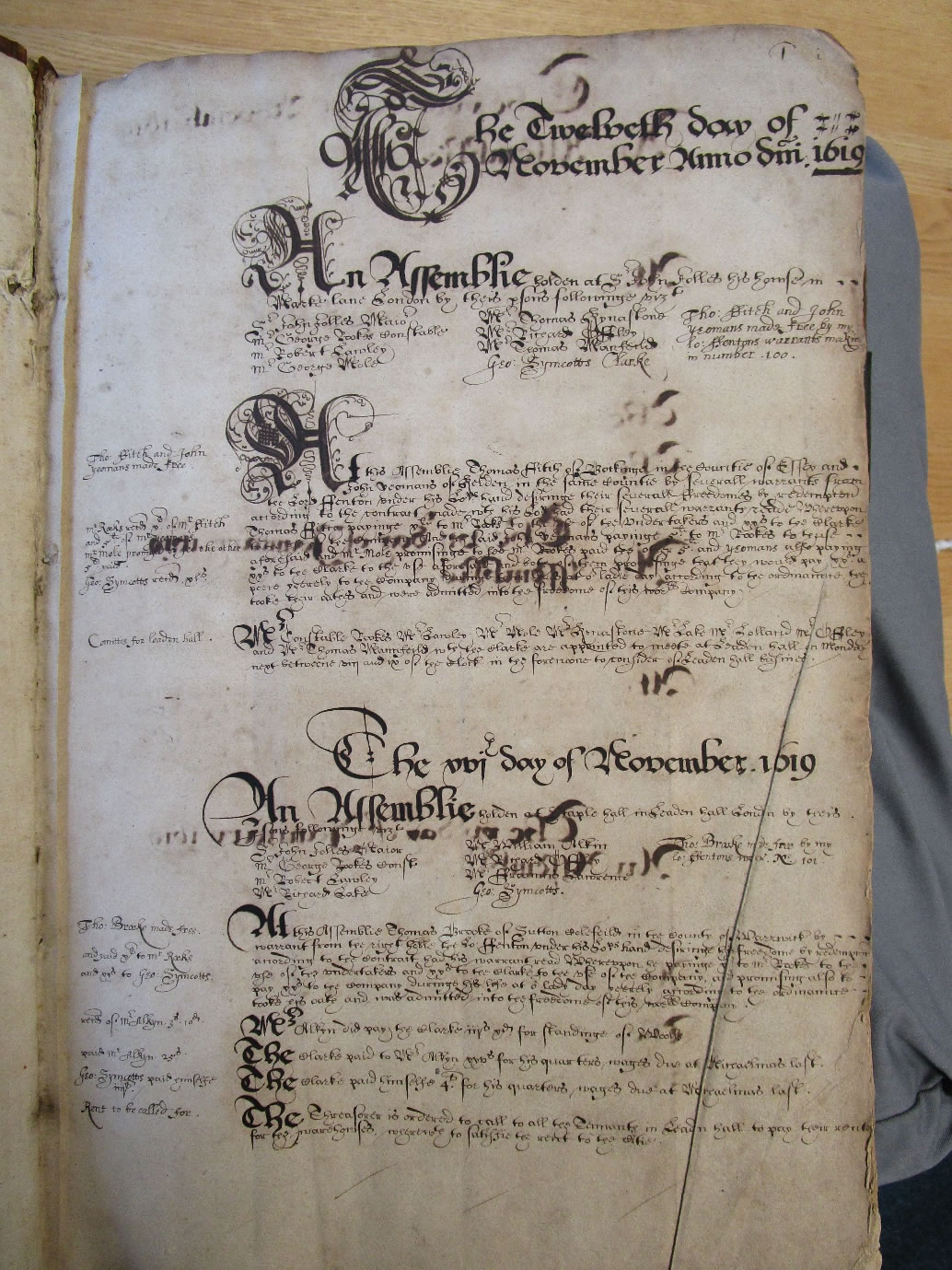
The 12th day of November 1619, an Assembly held at Sir John Jolles his house in Market Lane London
by these persons following
Tho: Fitch and John Yeomans made free by my Lord Fenton's [2] warrants making in number 100
- Sir John Jolles [1] Mayor
- Mr Thomas Kynastone
- Mr George Rookes Constable
- Mr Richard Offley
- Mr Robert Lawley [3]
- Mr Thomas Mansfeild
- Mr George Mole
- Geo: Symcotts Clerk
Thomas Fitch and John Yeomans made free.
Mr Rooks rcvd £10 of Mr Fitch and £5 of Mr Yeomans. Mr Mole promised to see the other £5 paid. Geo. Symcotts rcvd 40s
At this Assembly Thomas Fitch of Bocking in the county of Essex and John Yeomans of Keldon in the same county by several warrants from the Lord Fenton under his Lords hand desiring their several freedoms by redemption according to the contract made with his lordship's hand their several warrants read whereupon Thomas Fitch paying £10 to Mr Rookes to the use of the undertakers and 20s to the Clerk to the use of the Company. And the said John Yeomans paying £5 to Mr Rookes to these aforesaid and Mr Mole promising to see Mr Rookes paid the other 5 and Yeomans also paying 20s to the Clerk to the use aforesaid and both of them promising that they would pay 20s apiece yearly to the Company during their life at Our Lady day according to the ordinance took their oaths and were admitted into the freedom of this worshipful Company.
Committees for Leaden Hall
Mr Constable Rookes Mr Lawley Mr Mole Mr Kynastone Mr Lake Mr Holland Mr Offley and Mr Thomas Manfeild with the Clerk are appointed to meet at Leaden Hall on Monday next between 8 and 9 o'clock in the forenoon to consider of Leaden Hall business.
The 16th day of November 1619 An Assembly held at Staple Hall in Leaden Hall London
by these persons following present
Tho. Brooke made free by my Lord Fenton's warrant No. 101
- Sir John Jolles Mayor
- Mr William Alkin
- Mr George Rookes Constable
- Mr Richard Offley
- Mr Robert Lawley
- Mr Francis Lawrence
- Mr Richard Lake
- Geo. Symcotts
Thomas Brooke made free and paid £10 to Mr Rooks and 20s to Geo: Symcotts.
At this Assembly Thomas Brooke of Sutton Coldfeild in the county of Warwick by warrant from the right honourable the Lord Fenton under his Lordship's hand desiring his freedom by redemption according to the contract that his warrant read. Whereupon he paying £10 to Mr Rookes to the use of the undertakers and 20s to the Clerk to the use of the Company and promising also to pay 20s to the Company during his life at Our Lady Day yearly according to the ordinance took his oath and was admitted into the freedom of this worshipful Company.
received of Mr Alkin 3s 10d
Mr Alkin did pay the Clerk 3s 10d for standing of Wools.
paid Mr Alkin 25s
paid Mr Alkin 25s The Clerk paid to Mr Alkin 25s for the quarter's wages due at Michaelmas last.
Geo Symcotts paid himself £4.
Geo Symcotts paid himself £4. The Clerk paid himself £4 for his quarter's wages due at Michaelmas last.
Rent to be called for.
The Treasurer is ordered to call all the Tenants in Leaden Hall to pay their rents for the warehouses, wherewith to satisfy the rent to the City.
Notes:
- Sir John Jolles (died 31 May 1621) was a member of the Drapers’ livery company and Lord Mayor of London 1615.
- Lord Fenton was one of several ‘undertakers’ with influence at Court. The undertakers, here a guarantor, were apparently being repaid for their efforts in obtaining the Company's patent from King James in 1617. In 1611 Fenton was mentioned as Baron and Captains of the Kings Guard.
- Robert Lawley MP c1550 -27 July 1636 of Much Wenlock, Shropshire.
Quarter days were used for settling financial accounts : Lady Day 25th March, Midsummer, Michaelmas 29th September and Christmas Day (already abbreviated to Xmas by clerks).
Staplers Through History
William Browne d 1489 “of Stamford, Merchant of the Staple at Calais“. [will dated 4 July 1488]. 1446 Appointed as ambassador for the merchants of Holland, Zeeland and Flanders to the Duke of Burgundy. Member of the Calais Staple at least from 1449. As member he engages in moneylending, in particular to successive Kings of England, namely Henry VI, Edward IV, Edward V, Richard III and Henry VII in return for forfeited properties, licenses to export wool free of tax, and at least five royal pardons. Most of his moneylending activities took place during the War of the Roses which took place between 1455 and 1485. He founded Domus Dei (Browne’s Hospital) in Stamford. Twice Sheriff of Rutland in the reigns of Edward IV, Edward V & Henry VII.
http://www.lilfordhall.com/ElmesFamily/William-Browne.asp
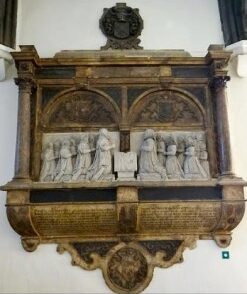
Among the many monuments to Merchants of the Staple are these in St Helens Church, Bishopsgate, London.
Sir Andrew Judd, Knight d 1588 Mayor of the Staple
His Monument in St Helens Church, Bishopsgate, London reads:
“TO RUSSIA AND MUSCOVA. TO SPAYNE SUNNY WITHOUT FABLE TRAVELD HE BY LAND AND SEA. BOTHE MAYRE OF LONDON AND STAPLE THE COMMONWELTHE HE NORISHED SO WORTHELIE IN ALL HIS DATES THAT ECH STATE FULLWELL HIM LOVED TO HIS PERPETUALL PRAYES. THREE WYVES HE HAD. ONE WAS MARY FOWER SUNES ONE MAYDE HAD HE BY HER. ANNYS HAD NONE BY HIM. TRULY BY DAME MARY HAD ONE DOWGHTER. THUS IN THE MONTH OF SEPTEMBER A THOUSANDE FYVE HUNDRED FYFTEY AND EYGHT DIED THIS WORTHIE STAPLAR WORSHIPYNCE HIS POSTERYTE”

John Robinson - died 1599.
Monument in St Helens Church, Bishopsgate, London.
Merchant of the Staple of England, free of the Company of Merchant Taylors and Alderman of London.